
A Detailed Guide to Choosing a Pharma Capsules Manufacturer in Baddi
Posted by ASPO Pharmaceuticals LLP
| November 13, 2025
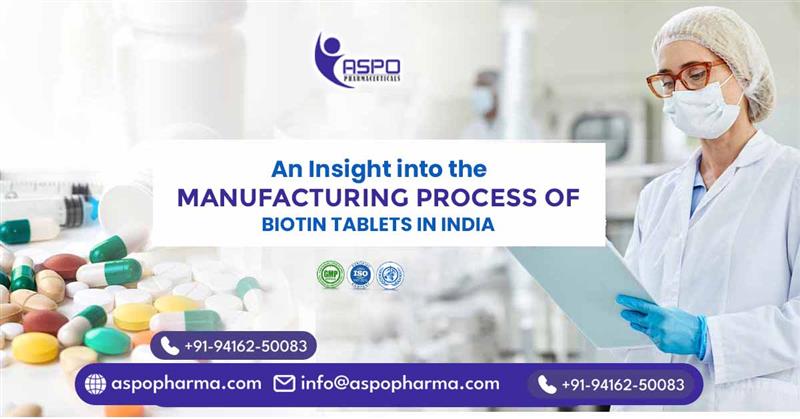
Manufacturing biotin tablets is an extremely complicated process. Hence, this raw powder is changed into a stable, orally administrable form. Biotin, or Vitamin B7 is an essential constituent in metabolism, hair, skin, and nail health. Hence, demand for supplements supports innovation by each biotin tablets manufacturer in the world. Moreover, this is a process that connects pharmaceutical technology with the science of nutraceuticals.
The process starts with weighing and mixing the active ingredient with several excipients in just the right proportions. This will be followed by granulation or direct compression.
In an ideal situation, the tablet obtained would provide uniform dosing and have great disintegration in the body. This comprehensive method will make sure that every single tablet has the same high quality, safety, and efficacy that Indian regulators expect.
Quality Control and Regulatory Compliance for Every Biotin Tablets Manufacturer in India
Essentially, for any biotin tablets manufacturer operating in India, quality assurance is a basic requirement, not an option. Implicitly, this means adherence to standards nationally and internationally. In addition, the regulatory authorities require exhaustive documentation at each step involved in the process. This constant adherence guarantees that the final result is safe, pure, and potent as declared.
Sourcing and Raw Material Testing
The process, therefore, begins with the stringent selection of raw materials, biotin powder, and other excipients. A Certificate of Analysis from the manufacturers for all incoming materials is, hence, required. As a matter of fact, materials must undergo mandatory in-house testing to confirm their freedom from heavy metals and microbial contamination and to confirm potency.
WHO-GMP Guidelines
A reliable biotin tablet manufacturer in India follows the WHO-GMP guidelines. As a result, it will ensure that products are manufactured and controlled consistently in accordance with quality standards appropriate for the intended use. On the other hand, it covers a wide range from facility design to personnel training.
Apparatus Calibration and Environmental Control
This involves the periodic calibration of production equipment such as blenders and tablet presses. Additionally, control of the manufacturing environment regarding humidity and temperature is important in guarding against the stability of biotin. This will prevent active ingredient degradation.
In-Process Checks and Validation
Manufacturing involves continuous quality checks. For instance, it checks on the hardness of the tablet, weight variation, and friability routinely. On top of it, process validation confirms that the defined manufacturing procedures will consistently produce a product.
Why Pharma Companies Must Prioritize WHO-GMP Compliance?
A reliable biotin tablet manufacturer in India follows the WHO-GMP guidelines. As a result, it will ensure that products are manufactured and controlled consistently in accordance with quality standards appropriate for the intended use. On the other hand, it covers a wide range from facility design to personnel training.
Final Product Release Testing
These finished biotin tablets will undergo dissolution tests and final assay tests before release. This final scrutiny by the biotin tablets manufacturer in India ultimately confirms the shelf life. This will ensure that the tablet will properly release the active ingredient in the human body.
From Powder to Tablet: Key Stages in the Technical Manufacturing Process of Biotin
This means that the technological steps of conversion from raw powder to the finished tablet are very precisely controlled. Hence, depending on the nature of the biotin raw material and the properties desired in the final tablet, usually a specific manufacturing method is selected: either Direct Compression or Wet Granulation.
The normal sequence of operations is very well-defined:
- Raw materials are sieved to ensure uniformity in particle size. Active biotin is blended with the fillers and binders in a validated mixer such as a V-Blender.
- A liquid binder solution is combined with the powder blend for WG. In turn, this provides wet granules that are dried by means of an FBD or fluidized bed dryer.
- The dried granules are milled to the appropriate size. The mixture is treated with a lubricant, such as Magnesium Stearate. This prevents the material from sticking to the tablet press machinery.
- The lubricated blend is fed into a rotary tablet press. In fact, this machine applies thousands of pounds of pressure, thus forming the tablets. The press then guarantees the same weight and hardness for every single piece.
- The tablets that have just been compressed will be sent to the deduster, where the loose powder on their surface will be removed. At this point, it will be ready for the last coating process.
Advanced Formulation: Understanding the Role of Excipients and Coatings in Biotin Tablets
The efficacy of the tablet rests equally on the non-active ingredients or excipients as on the biotin itself. Therefore, this part of the formulation process in the production of the vitamin requires a high level of skill. Excipients perform various significant roles: they provide bulk (fillers), enhance the flow of the material (glidants), and facilitate the integration of the tablet in the body (disintegrants). In addition, coating creates a layered protection and refinement that is quite complex. Thus, the process of applying a specialized film coat by a modern biotin tablets manufacturer in India is commonly used. This coating usually serves multiple purposes: it masks any unpleasant taste that might be inherent to the vitamin.
It also protects the active biotin from moisture and light, major factors in its degradation. On the other hand, it enhances the aesthetics of the tablet to improve its ease of swallowing. The exact combination of excipients and a final coating of Aspo Pharma are used to ensure that the premium product gets to the consumer with maximum stability.
Final Thoughts
A reliable biotin tablet manufacturer, ASPO Pharma, is the perfect example of hard regulatory compliance combined with top-notch technology. Choosing a certified biotin tablets manufacturer is one of the most important keys to product success. As a multi-stage process, it ensures safe and therapeutically dosed efficacy for customers around the world. This will eventually solidify India’s position as one of the most important sources of quality nutraceuticals.
Frequently Asked Questions (FAQs)
What is the primary function of a tablet’s protective coating?
This coating also protects biotin from moisture and light; therefore, it greatly enhances the stability and shelf life of the product in general.
Are the quality standards for these nutritional supplements internationally recognized?
Yes, leading manufacturers follow international quality benchmarks such as WHO-GMP and ISO standards in production.
Why is “direct compression” often favored for manufacturing biotin tablets?
Among all methods, direct compression is one of the best. Since it exposes the product to less heat, it prevents thermal degradation of biotin in processing.
What is a critical safety check performed on the initial raw biotin powder?
The essential check is assurance that the active ingredient is pure and free from harmful heavy metals and microbial contamination.
Contact ASPO Pharma
Plant Address: Plot No – 10, Himuda Industrial Area, Bhatauli Kalan, Baddi, Himachal Pradesh 173205
Email Address: aspopharma@gmail.com
Phone Number: +91-8950191795
Contact Us
Recent blogs
 Derma Products Manufacturer: Everything You Need to Know About Skincare Production and Quality Standards
 Pharma Ointment Manufacturer in Baddi: Complete Guide to Quality Production & Industry Standards
 Pharma Syrup Manufacturer in India: Quality Standards, Manufacturing Process, and Business Benefits
 Levocetirizine Montelukast Third Party Manufacturer: A Complete Business Guide